
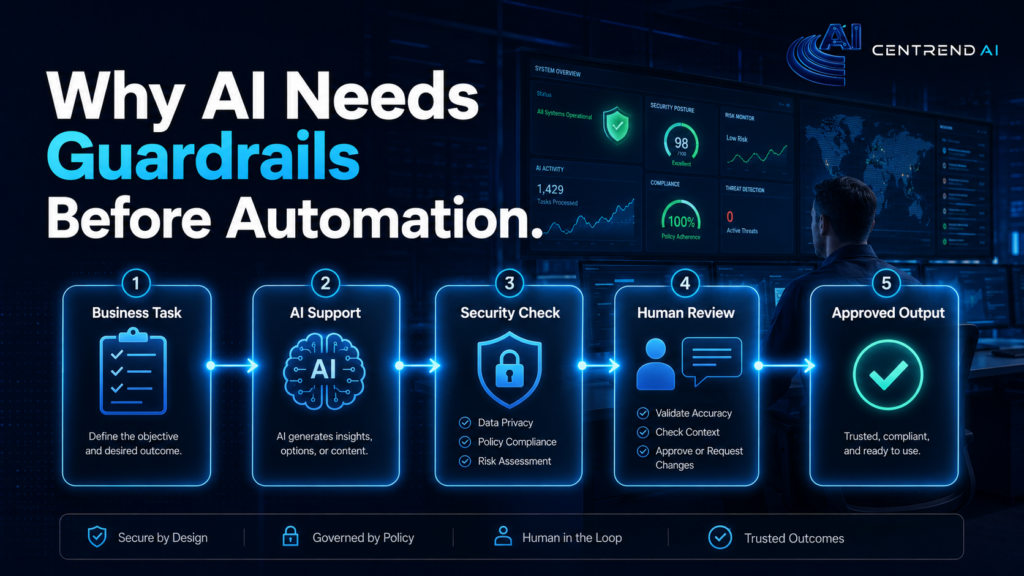
Why AI needs guardrails before automation is simple: speed without control creates risk.
AI can help teams move faster, reduce repetitive work, and improve daily decisions. But when teams add automation without clear rules, AI can also move bad data, missed steps, and poor decisions faster.
The problem
Many businesses want AI to save time right away.
So they start with the tool.
They connect AI to emails, documents, reports, customer records, or workflows before asking the most important questions:
- What can AI access?
- What should AI never touch?
- Who reviews the output?
- Who owns the decision?
- What happens if the result is wrong?
Without those answers, AI becomes another risk inside the workflow.
Why it matters
Automation does not just complete tasks.
It can send messages, summarize data, trigger next steps, create drafts, surface recommendations, and influence decisions.
That means one unclear rule can create bigger problems:
- AI may expose sensitive data
- Teams may reuse incorrect information
- Approval steps may be skipped
- Employees may rely on unverified outputs
- No one may know who is responsible
The bottom line: AI should support the workflow, not run ahead of the business.
The better approach
Before automating, define the guardrails.
Guardrails are the rules that keep AI useful, safe, and controlled.
They should answer:
- Which tools are approved?
- Which data sources are trusted?
- Which tasks can AI support?
- Which actions require human approval?
- Who checks accuracy?
- How will success be measured?
This does not slow AI down. It makes AI safer to use.
Where human review belongs
AI can draft, summarize, organize, and recommend.
People still need to review, approve, and take responsibility.
Human review matters most when AI is used for:
- Customer communication
- Financial information
- Legal or compliance-related content
- Sensitive company data
- Security decisions
- Public-facing messages
- Business-critical workflows
AI can help prepare the work. A person should still own the final decision.
What strong AI guardrails look like
A safer AI workflow includes:
- Clear ownership
- Approved tools
- Limited data access
- Reliable information sources
- Human review points
- Defined approval steps
- Simple success metrics
Once these are in place, AI has a clear role.
It becomes a controlled business tool, not an unmanaged shortcut.
The big picture
AI can create real value when it is built around the right process.
But automation should not come first.
Start with the business problem. Fix the workflow. Set the guardrails. Then use AI where it can help without adding confusion or unnecessary risk.
Guardrails first. Automation second.
TL;DR
- AI can move work faster, but speed needs control
- Automation without rules can scale mistakes
- Guardrails define access, ownership, review, and approval
- Human review keeps people responsible for important decisions
- Safer AI starts with clear workflows and trusted information
- The best AI use case is focused, reviewed, and measurable
Build AI With Confidence
Centrend AI helps businesses identify practical AI opportunities, define safe workflows, and put the right guardrails in place before automation expands.
Ready to use AI without losing control? Book an AI readiness review with Centrend AI.