
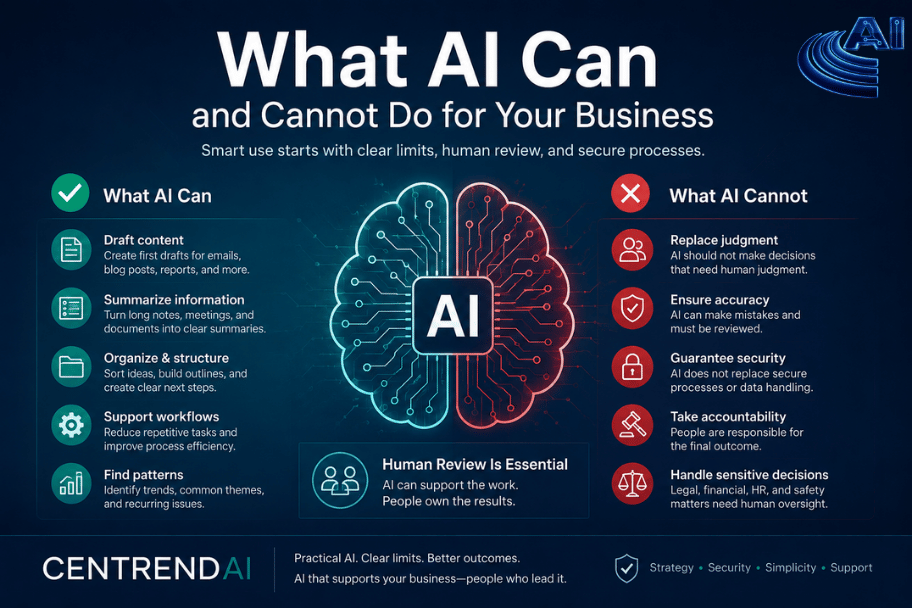
What AI can do for your business is powerful, but it still needs clear limits, human review, and secure processes to be useful.
AI can help your business work faster.
But it cannot replace judgment, accountability, or a secure process.
That is where many businesses get stuck.
They expect AI to solve everything. Then they realize the tool still needs clear direction, good information, human review, and the right guardrails.
The smartest AI strategy starts with knowing its limits.
The problem
AI can create a draft in seconds.
It can summarize notes.
Or can organize information.
It can help with repetitive tasks.
But AI can also make mistakes.
It can misunderstand context.
And can use outdated information.
It can sound confident even when the answer needs review.
That means AI should not be treated like a decision-maker.
It should be treated like a support tool.
Why this matters
Businesses are using AI for emails, reports, research, customer communication, meeting notes, and workflow support.
That can create real value.
But only when AI is used in the right place.
If a business gives AI too much responsibility too soon, it can create:
- Inaccurate answers
- Unchecked customer replies
- Privacy concerns
- Confusing workflows
- Poor decisions
- Extra review work
- Security risks
The goal is not to use AI everywhere.
The goal is to use AI where it actually helps.
What AI can do well
AI works best when the task is clear, repetitive, and easy to review.
It can help with:
1. Drafting
AI can help create first drafts for emails, updates, outlines, blog ideas, internal messages, and basic customer response drafts.
But the final version should still be reviewed by a person.
2. Summarizing
AI can turn long notes, meetings, articles, or documents into shorter summaries.
But someone still needs to check the accuracy and context.
3. Organizing information
AI can help sort ideas, structure notes, create checklists, and turn messy input into clearer next steps.
This is useful when the business already knows the goal.
4. Supporting workflows
AI can help reduce repeated manual work, prepare routine content, route information, and support simple internal processes.
But the workflow needs to be clear first.
5. Finding patterns
AI can help highlight repeated issues, common questions, or recurring themes.
But people still need to decide what those patterns mean.
What AI should not do alone
AI should not own the final result.
It should not replace the people responsible for the work.
AI should not make final decisions on:
- Legal matters
- Financial approvals
- HR issues
- Security actions
- Customer commitments
- Medical or safety-related guidance
- Sensitive business decisions
- Anything that needs clear accountability
AI can support the process.
People still need to lead it.
AI cannot fix a broken process
If the workflow is unclear, AI will not magically make it better.
It may only move the confusion faster.
Before adding AI, businesses should ask:
- What problem are we trying to solve?
- Is the process already clear?
- What information will AI use?
- Who reviews the output?
- What should AI never handle?
- How will we measure the result?
If those questions are not answered, AI may create more work instead of reducing it.
AI needs human review
Human review is not a small detail.
It is what keeps AI useful, accurate, and safe.
A good AI process should include:
- Approved tools
- Clean information sources
- Clear usage rules
- Secure data handling
- Review steps
- Final human approval
- Accountability for the outcome
AI can help move work forward.
Human review keeps the work aligned with the business.
The better approach
Start with one clear use case.
Choose something simple.
Keep it low risk.
Make it easy to review.
Measure whether it saves time, improves quality, or reduces repeated work.
Then decide whether to expand.
That is how AI becomes practical.
Not overwhelming.
Nor risky.
Not disconnected from the business.
The bottom line
AI can help your business work faster, organize information, and reduce repetitive tasks.
But it cannot replace strategy, judgment, security, or accountability.
The best AI use starts with clear limits.
Know what AI can do.
Know what it should not do.
Then build a process that keeps people in control.
Use AI with clarity and control
Centrend AI helps businesses identify practical AI opportunities, set safer guardrails, and build workflows that support the team without adding confusion.
Not sure where AI fits in your business? Talk to Centrend AI to find one practical use case, define the right limits, and build a safer path forward.