
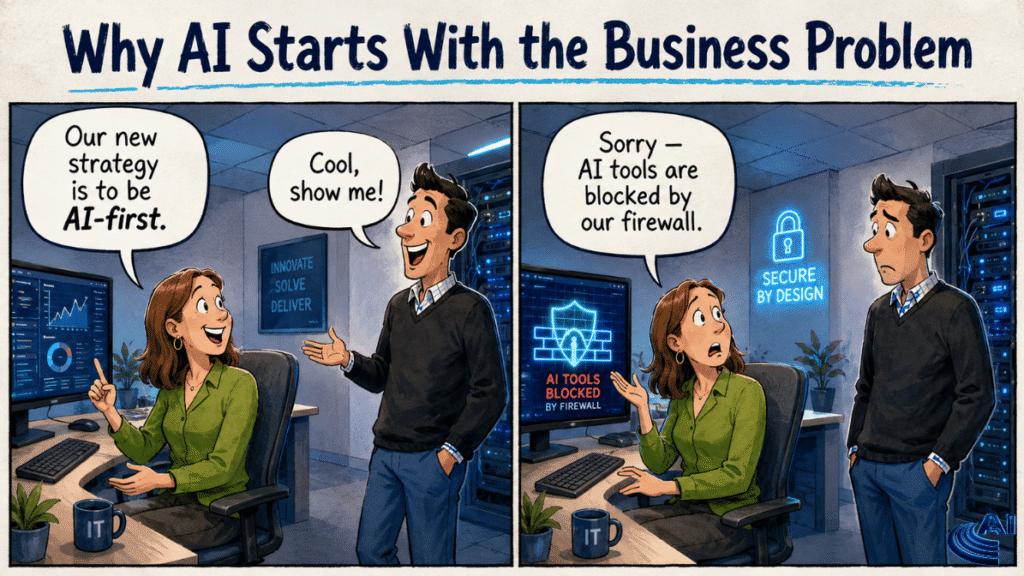
Why AI projects fail often has less to do with the technology and more to do with how the project begins.
A business finds an impressive AI tool, signs up, and then looks for somewhere to use it. But even a powerful tool can create more confusion when the actual business problem is unclear.
Why it matters
AI should reduce work, improve access to information, or help a team make better decisions.
It should not become another system employees must learn, manage, and correct.
When a business starts with the tool instead of the problem, it may end up with:
- Another unused subscription
- More steps in an already unclear workflow
- Inaccurate or inconsistent outputs
- Sensitive information entered without clear rules
- No one responsible for reviewing the results
- No clear way to measure success
The bottom line: AI cannot fix a process the business does not fully understand.
A common mistake
Imagine a team regularly misses customer follow-ups.
The quick answer may be to automate them with AI. But first, the business needs to understand why follow-ups are being missed.
Is there no clear owner?
Are requests coming from too many places?
Is customer information incomplete?
Does the team lack a consistent process?
Without those answers, AI may simply automate the confusion. It could send the wrong message, use incomplete information, or create more work for employees to correct.
Start with the friction
Before choosing a tool, ask:
What task, delay, or information gap is slowing the team down?
Strong opportunities often include:
- Answering repeated internal questions
- Summarizing documents or reports
- Preparing meeting notes and action items
- Organizing incoming requests
- Drafting routine follow-ups
- Finding approved company information
- Extracting details from forms
- Preparing recurring updates
These are business problems first. AI is only one possible solution.
What makes a good first AI use case?
A strong first project should be:
Clear: The team can explain the problem in one or two sentences.
Repetitive: The task happens often enough to make improvement worthwhile.
Measurable: The business can compare the process before and after AI.
Reviewable: A person can check the output before it affects a customer or decision.
Manageable: The project can be tested without changing the entire business.
The best first use case is rarely the biggest idea. It is usually one focused opportunity that can be tested safely.
Define success first
“Use AI to improve productivity” is too broad.
A clearer goal would be:
Reduce the time needed to prepare the weekly report while keeping a manager’s review before it is shared.
A useful goal explains:
- What should improve
- Who owns the process
- How the result will be reviewed
- How success will be measured
Without that clarity, the business cannot tell whether AI is actually helping.
Keep people in control
AI can support routine work, but responsibility should stay with the business.
Human review is especially important for:
- Customer commitments
- Financial information
- Sensitive company data
- Legal or compliance matters
- Public-facing content
- High-impact decisions
The goal is not to remove people from the workflow. It is to give them better support and more time for work that requires judgment.
A practical way to start
Centrend AI recommends five clear steps:
1. Find the real problem
Identify repeated work, delays, errors, or information gaps.
2. Review the current workflow
Understand who does the work, what information is used, and where problems occur.
3. Choose one opportunity
Start with a focused, useful, and manageable use case.
4. Add guardrails
Set clear rules for data, access, ownership, review, and approval.
5. Test and measure
Run a controlled pilot and expand only after the value is proven.
The big picture
The first question should not be:
Which AI tool should we buy?
It should be:
Which business problem are we trying to solve?
Once that answer is clear, choosing the right tool becomes easier. So does defining human review, protecting information, and measuring the result.
That is why AI starts with the business problem.
The tool comes later.
TL;DR
- Start with the problem, not the product
- Understand the workflow before automating it
- Choose one focused and measurable use case
- Assign clear ownership
- Keep human review where accuracy matters
- Prove value before expanding
Find Your First Practical AI Win
Centrend AI helps businesses identify useful AI opportunities, improve workflows, and introduce AI with clear controls.
The goal is not to automate everything.
The goal is to solve the right problem in a practical and responsible way.
Ready to find your first practical AI opportunity? Book an intro call with Centrend AI.
Have questions about where AI fits your business? Contact Centrend AI and let’s start with clarity.
Download the Practical AI for Growing Businesses brochure to see how Centrend turns AI ideas into focused, responsible action.