
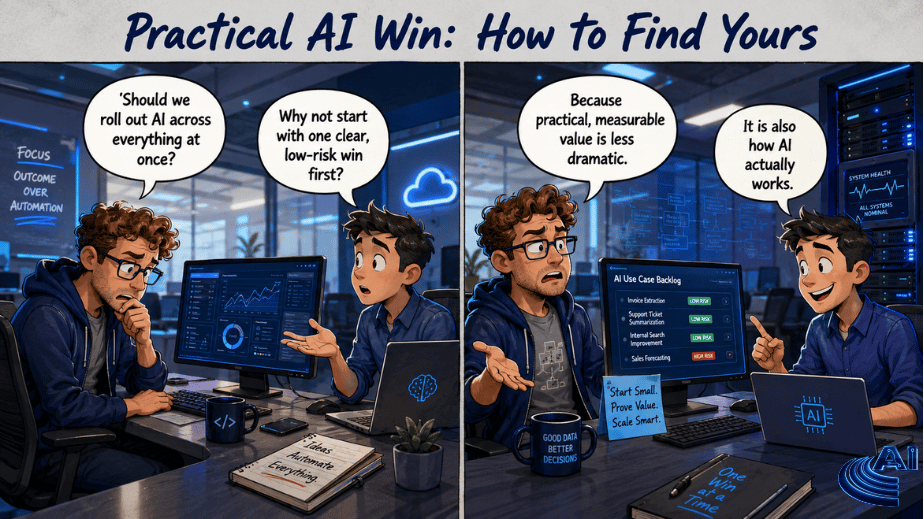
Practical AI win starts with one clear business problem.
Not the newest tool.
Not the biggest automation project.
And not an attempt to use AI everywhere at once.
Many businesses rush into AI without deciding what work actually needs improvement. They test several platforms, automate unclear processes, and create more review instead of less work.
A better approach is simple:
Choose one low-risk, high-value task where AI can create a measurable improvement.
Why businesses struggle to start
AI can support emails, reports, research, meetings, customer communication, and daily operations.
The challenge is not finding possible uses.
It is choosing the right first one.
Businesses often make two mistakes:
- Selecting a tool before defining the problem
- Starting with a large or sensitive process too soon
Your first AI project does not need to transform the company.
It needs to solve one real problem well.
What makes an AI use case practical?
A strong first use case is usually:
- Repetitive
- Time-consuming
- Easy to define
- Low-risk
- Simple to review
- Connected to a measurable result
Your team should also know:
- What AI will handle
- What information it can use
- Who reviews the output
- When a person takes over
- How success will be measured
If those answers are unclear, the workflow may not be ready.
Five questions to ask first
1. Does the task happen often?
Look for work completed daily or weekly.
Repeated tasks create more opportunities to save time and measure improvement.
2. Is the process already clear?
AI works best when the steps, responsibilities, and expected result are understood.
Automating an unclear process usually creates faster confusion.
3. Is the risk manageable?
Avoid beginning with legal decisions, financial approvals, employee matters, sensitive customer issues, or major business commitments.
Start where mistakes can be caught before they cause harm.
4. Can someone review the result?
A person should be able to check the facts, tone, context, and final output quickly.
If reviewing the work takes longer than doing it manually, the workflow may not create value.
5. Can you measure the improvement?
Track the original time, steps, delays, corrections, and review requirements.
Then compare them with the AI-supported process.
Safe first AI wins
Possible starting points include:
Meeting summaries
Turn notes into key decisions, action items, and follow-up lists.
First-draft communication
Transform rough notes into internal updates or routine response drafts.
Report outlines
Organize ideas and create a useful first structure.
Knowledge support
Help employees find approved documents, procedures, and internal answers faster.
Routine task routing
Categorize incoming requests and direct them to the right person.
AI can prepare and organize the work.
People should still verify and approve the result.
What should not be automated first
Avoid starting with work that depends heavily on judgment, empathy, accountability, or sensitive information.
That includes:
- Final legal conclusions
- Financial approvals
- Hiring or termination decisions
- Sensitive customer disputes
- Safety-related decisions
- Major strategic commitments
- Broken or undefined processes
AI may support these areas by organizing information.
It should not own the final decision.
How to test the workflow
Keep the first pilot focused.
Define the problem
Identify the exact friction you want to remove.
Set one goal
Choose a measurable result, such as reducing drafting time, improving information access, or shortening follow-up time.
Set boundaries
Define approved data, users, review steps, handoff points, and ownership.
Start small
Test the workflow with one team, task, or department.
Measure the full process
Include the time spent prompting, reviewing, correcting, approving, and completing the work.
Fast AI output does not matter if the team spends more time fixing it.
Improve before expanding
The pilot may reveal:
- Missing information
- Weak instructions
- Unclear ownership
- Extra review steps
- Security concerns
- Training needs
Use those findings to improve the process.
Expand only when the workflow consistently delivers:
- Real time savings
- Less rework
- Reliable output
- Clear ownership
- Manageable review
- Protected information
The bottom line
Your business does not need AI everywhere.
It needs one useful place to begin.
The smartest first AI project is the one that solves a clear problem, fits the workflow, keeps risk manageable, and produces measurable value.
Start small.
Measure the full process.
Improve what works.
Then expand with confidence.
Find your first practical AI win
Centrend helps businesses identify valuable AI opportunities, build safer workflows, and test one focused pilot before scaling.
Not sure where AI should begin in your business? Contact Centrend to find one practical opportunity with clear value and manageable risk.
Explore the Centrend AI Approach
Want a clearer view of how Centrend helps businesses move from an AI idea to a practical, controlled rollout?
Explore the Centrend AI brochure to learn about our strategy, workflows, automation, training, guardrails, and pilot process.